
2026 Top Galvanized Steel Coil Manufacturer Guide

The 2026 Top Galvanized Steel Coil Manufacturer Guide examines how buyers can evaluate suppliers with confidence. It focuses on production capability, coating consistency, material traceability, and practical customer support. A reliable Galvanized Steel Coil Manufacturer should provide clear mill certificates, accurate dimensions, and repeatable quality across different batches.

Real performance begins with measurable details. Zinc coating thickness affects corrosion resistance, forming behavior, and service life. Surface appearance also matters, especially when coils are used for roofing, ductwork, automotive parts, or appliances. Buyers should review tensile strength, yield strength, elongation, coil weight, and edge condition. Small differences can create serious processing problems.

Factory evidence matters.

This guide considers galvanizing lines, annealing systems, slitting equipment, packaging methods, and inspection procedures. It also looks at shipment planning, response speed, and after-sales communication. A supplier may offer impressive photographs, yet photographs cannot replace test reports or a factory audit. That point is easy to overlook.

The discussion combines industry practice with a careful review of supplier claims. It recognizes that no manufacturer is perfect, and quality can vary under pressure, during peak seasons, or after specification changes. Buyers should ask precise questions, compare samples, and confirm standards before placing large orders. Environmental responsibility and responsible sourcing receive attention as well. The strongest manufacturers do not merely sell galvanized coils; they document how each coil was made, tested, packed, and delivered. This approach helps importers, fabricators, engineers, and distributors make decisions based on evidence rather than attractive promises.
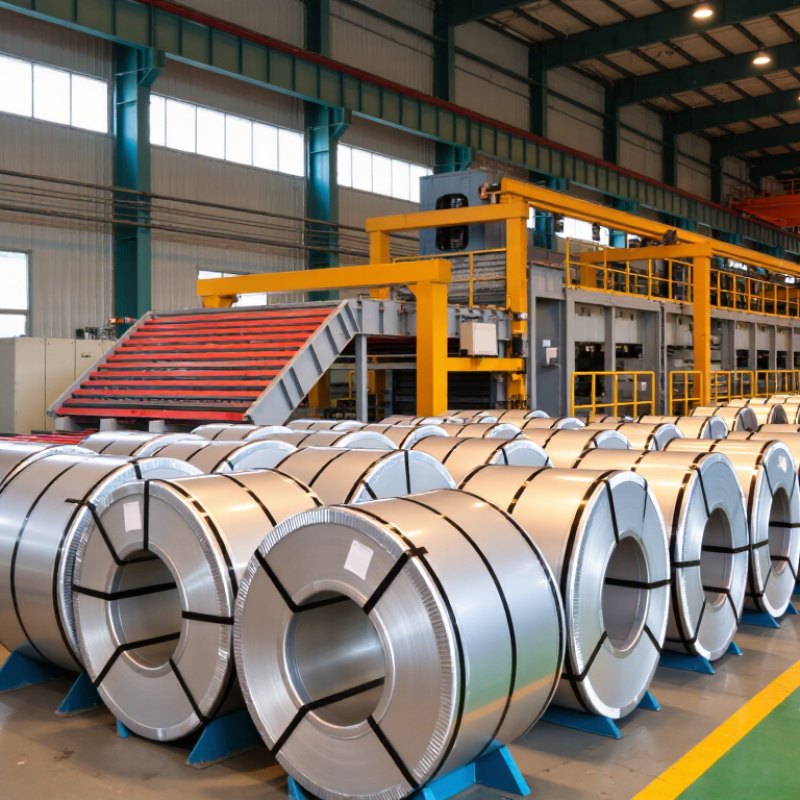
2026 Top Galvanized Steel Coil Manufacturer Guide

What Is Galvanized Steel Coil and How Is It Made?

2026 Top Galvanized Steel Coil Manufacturer Guide

Galvanized steel coil is steel sheet protected by a zinc coating. The zinc barrier slows rust, even when the surface faces rain, humidity, or factory moisture. Most coils begin with cold-rolled or hot-rolled steel. In plant production, cleaning matters more than many buyers expect. Oil, scale, and dust can weaken coating adhesion.

The prepared strip enters a molten zinc bath, usually near 450°C. Zinc bonds with the steel surface through controlled metallurgical reactions. Air knives then regulate coating thickness across the moving strip. The coil cools, passes through inspection equipment, and is recoiled for shipment. Technicians check coating weight, surface appearance, thickness, flatness, and edge quality. No coil is perfect. Small variations can still appear, especially near edges or during line changes.

Tips: Ask for the steel grade, zinc coating designation, coil width, and tolerance before ordering. Request test records and inspect sample surfaces under clear lighting. A bright finish looks attractive, but performance depends more on coating consistency and substrate quality. Storage also matters; trapped moisture between coils may cause white rust. Keep coils dry, ventilated, and slightly elevated. The process seems straightforward, but choosing the wrong specification can create expensive problems later.

Key Specifications for Comparing Galvanized Steel Coil Manufacturers

2026 Top Galvanized Steel Coil Manufacturer Guide

Comparing galvanized steel coil manufacturers requires more than checking price. Start with the steel grade, thickness, width, and coating designation. ASTM A653/A653M lists coating classes such as G90, while EN 10346 uses designations like Z275. These values describe zinc mass, not paint thickness. Confirm whether the figure applies to both surfaces.

The World Steel Association’s World Steel in Figures 2025 reports global crude steel production of about 1.88 billion tonnes in 2024. This scale increases supply choices, but it also makes traceability more important. Request mill test certificates, coating-weight results, dimensional tolerances, and mechanical properties. Check yield strength, tensile strength, elongation, flatness, and coil weight. A reliable manufacturer should explain testing frequency and sampling locations. One weakness remains: certificates may look complete while omitting edge-coating performance.

Tips: Ask for a recent inspection report. Compare the same standard. Verify coating mass independently when the application is demanding. Examine sample edges for uneven zinc, bare spots, or excessive spangle. For construction, confirm corrosion expectations with ISO 9223 exposure guidance, not only sales claims.

Production consistency often matters more than a single impressive test value. Review batch-to-batch variation, packaging protection, minimum order quantities, and delivery records. The International Energy Agency’s recent steel-sector analysis highlights rising pressure to reduce emissions, so request product-carbon data where procurement policies require it. Be careful with vague “eco” language. It is not a specification. A practical comparison sheet should show every value, test method, tolerance, and document revision. I would leave uncertain fields blank rather than assume compliance.

How to Evaluate a Galvanized Steel Coil Manufacturer in 2026

2026 Top Galvanized Steel Coil Manufacturer Guide

How to Evaluate a Galvanized Steel Coil Manufacturer in 2026

A reliable manufacturer should explain its steel grade, coating mass, yield strength, and dimensional tolerances clearly. Ask for recent mill certificates, production records, and independent test results. Do not rely on a polished brochure.

Request a physical sample before placing a large order. Inspect the coil surface under strong light. Look for bare spots, uneven spangles, edge cracks, oil stains, and handling dents. Measure thickness at several points. Check the coating mass through a recognized laboratory method, not visual appearance alone. Surface brightness can mislead.

Traceability matters. Each coil should connect to a heat number, coating line, inspection record, and packing label. Visit the facility if possible, or arrange a live production audit. Review furnace control, bath chemistry, tension leveling, slitting accuracy, and moisture-resistant packaging. Ask how the manufacturer handles failed tests, late shipments, and customer complaints. Their corrective-action records often reveal more than sales claims.

Experience helps, but it is not proof. During one inspection, a seemingly acceptable coil showed small burrs after slitting. The first checklist missed them. That mistake changed the inspection routine. A dependable supplier accepts questions, shares limitations, and provides consistent data across repeated batches. Delivery promises should also include realistic buffer time, especially during capacity changes or port delays.

2026 Top Galvanized Steel Coil Manufacturer Guide - How to Evaluate a Galvanized Steel Coil Manufacturer in 2026

Manufacturer evaluation data table based on commonly used galvanized steel standards, procurement practices, quality-control requirements, and practical supply benchmarks.

Evaluation Dimension Recommended 2026 Benchmark Data to Request from the Manufacturer Why It Matters Suggested Weight
Applicable Product Standard Conformity with ASTM A653/A653M, EN 10346, JIS G3302, or an equivalent specification agreed in the purchase contract. Product certificate, standard edition, chemical composition, mechanical properties, coating designation, and inspection method. Clearly defined standards reduce disputes concerning coating mass, tolerances, surface quality, and mechanical performance. 10%
Steel Grade and Mechanical Properties Common commercial forming grades generally require yield strength around 140–280 MPa, tensile strength around 270–350 MPa, and elongation commonly above 20%, depending on the specified grade. Heat number, mill test certificate, yield strength, tensile strength, elongation, and test direction. Mechanical properties determine formability, bending performance, structural capacity, and suitability for stamping or roll forming. 12%
Zinc Coating Mass Typical coating designations range from approximately 60 to 350 g/m² total on both sides. Z275 corresponds to approximately 275 g/m² total coating mass. Coating designation, coating-mass test results, side-to-side distribution, and test locations. Higher and more uniform zinc coating generally improves corrosion protection, but it may affect forming, welding, and cost. 15%
Coating Uniformity Coating mass should remain within the tolerance specified by the applicable standard, with no exposed steel, bare spots, blistering, flaking, or excessive zinc buildup. Three-point or single-point coating test results, inspection records, and photographs of representative coil surfaces. Uniform coating supports predictable corrosion resistance and improves downstream painting and forming consistency. 10%
Base-Metal Thickness and Width Common commercial thickness range: approximately 0.25–3.00 mm. Common supply width range: approximately 600–1,600 mm, subject to mill capability. Ordered thickness, actual base-metal thickness, coating thickness treatment, width tolerance, and measurement procedure. Accurate dimensions help prevent assembly problems, excess material consumption, and production-line downtime. 10%
Flatness, Camber, and Shape Flatness and camber should comply with the selected standard and agreed order tolerance; edge wave, center buckle, and coil set should be controlled. Flatness inspection report, camber measurements, shape-control process, and sample inspection photographs. Poor shape quality can cause feeding, leveling, slitting, roll-forming, and panel-assembly problems. 8%
Surface Finish and Spangle Surface options may include regular spangle, minimized spangle, or zero-spangle appearance. The selected finish should be consistent across the coil. Surface-finish specification, sample panels, oiling or passivation details, and defect acceptance criteria. Surface appearance affects painting, appliance panels, roofing applications, and customer acceptance. 8%
Corrosion-Protection System The supplier should identify zinc coating mass, surface treatment, oiling condition, storage recommendations, and the intended exposure environment. Technical data sheet, salt-spray or cyclic-corrosion data where relevant, storage guidance, and recommended processing conditions. Corrosion performance depends on the complete protection system, not zinc mass alone. 8%
Quality Management and Traceability A documented quality-management system, heat-number traceability, calibrated testing equipment, and retained inspection records should be available. Quality certificate, calibration records, process-control plan, nonconformance procedure, and traceability sample. Traceability allows the buyer to identify affected coils quickly and verify whether corrective action is effective. 10%
Production and Testing Capability The manufacturer should have suitable galvanizing, leveling, slitting, recoiling, coating-mass testing, dimensional testing, and mechanical-testing capability. Equipment list, production-line specifications, laboratory capability, annual capacity range, and maintenance records. In-house capability can improve consistency, shorten response time, and reduce dependence on subcontracted processing. 7%
Order Minimum and Supply Flexibility A competitive supplier should clearly state minimum order quantity, available coil weights, slit-width options, trial-order policy, and mixed-specification limitations. Quotation terms, production schedule, minimum order quantity, coil-weight range, and sample-order conditions. Flexible ordering lowers inventory risk and makes qualification easier for new or specialized applications. 5%
Lead Time and Delivery Reliability For standard material, a practical planning range is often 3–8 weeks after order confirmation; customized specifications may require additional time. Recent on-time-delivery performance, production lead time, shipping terms, loading plan, and delay-escalation process. Reliable delivery is essential for continuous manufacturing and reduces the need for costly safety stock. 7%
Packaging and Transport Protection Packaging should protect against moisture, edge damage, telescoping, coil movement, and corrosion during handling and transit. Packaging drawings, coil-eye orientation, moisture barrier details, lifting method, marking format, and loading photographs. Correct packaging prevents transit damage and reduces the risk of wet-storage staining and handling deformation. 5%
Technical Support and Claims Handling The supplier should provide a named technical contact, documented complaint procedure, root-cause analysis, corrective-action report, and response timeline. Claim form, response-service-level agreement, sample corrective-action report, and escalation contacts. Fast technical support limits production disruption when surface, dimensional, or processing issues occur. 5%

Leading Applications and Industry Requirements for Galvanized Steel Coil

2026 Top Galvanized Steel Coil Manufacturer Guide

Galvanized steel coil supports construction, automotive, appliance, and agricultural applications. Its zinc coating protects the steel from moisture and surface corrosion. Roofing panels need stable coating coverage, accurate thickness, and reliable forming performance. Automotive parts demand clean surfaces, consistent mechanical properties, and resistance to stamping damage. HVAC ducts and appliance panels often require smooth finishes for painting or visible installation.

Application requirements should guide coil selection. Roll-forming lines need controlled flatness and predictable elongation. Deep-drawing components need suitable yield strength and ductility. Coating mass must match the expected exposure, not merely the lowest purchase price. Indoor products may need less protection than coastal roofing or outdoor equipment. Relevant standards should be verified with current project specifications and regional regulations.

In production practice, buyers should review chemical analysis, coating test results, tensile data, and dimensional records. Traceability matters when coils are slit, stamped, or delivered in several batches. Visual inspection can reveal bare spots, edge cracking, excessive spangle, or uneven coating. Salt spray testing is useful, but it cannot represent every real environment. That assumption needs reconsideration. Forming trials and outdoor exposure data may provide better evidence. Packaging also matters; wet storage can create white rust before installation, especially when ventilation is poor. A dependable manufacturer should explain these risks clearly and provide inspection records that match the delivered coil.

Quality Standards, Pricing Factors, and Supplier Selection Criteria

2026 Top Galvanized Steel Coil Manufacturer Guide

Reliable galvanized steel coil purchasing starts with measurable quality standards. Check zinc coating mass, coating uniformity, tensile strength, yield strength, elongation, and dimensional tolerance. Surface appearance also matters. Look for clean edges, consistent spangle, and minimal scratches after uncoiling. Ask for mill test certificates, inspection records, and batch traceability. A certificate alone is not enough. Confirm that test methods match your required standard and application.

Pricing depends on more than the base steel rate. Zinc consumption, coil width, thickness, order volume, energy costs, packaging, inland freight, and export logistics can change the final quotation. Narrow tolerances often increase processing costs. Special surface treatments may add another charge. Request a detailed breakdown instead of comparing only the headline price. In my experience, the cheapest offer sometimes hides weaker packaging or longer production times. That lesson is easy to ignore during urgent purchasing.

Tips: Compare three written quotations. Request a sample coil or small trial order. Check coating measurements from several coil areas. Ask how claims are handled. Visit the production site when possible, and review equipment maintenance records. Select a supplier with stable capacity, transparent communication, and practical technical support. No supplier is flawless. I have also seen carefully audited factories miss minor edge damage, so incoming inspection should remain part of your process. Supplier selection is not just a price decision. It is a risk decision.

2026 Top Galvanized Steel Coil Manufacturer Guide

Standard galvanized coating designations provide a practical quality benchmark when comparing steel coil suppliers. Higher zinc coating mass generally improves corrosion resistance, but it can also increase material cost, so buyers should balance coating requirements with forming performance, delivery capability, certification, and total landed cost.

Reference basis: common EN 10346 Z coating designations. Values represent nominal total zinc coating mass on both surfaces, measured in g/m². Actual product availability, dimensional tolerances, mechanical properties, and inspection requirements should be confirmed against the selected standard and purchase specification.

Enter search term below