7 Best Large Pivot Door Manufacturers for Global Buyers?
A Large Pivot Door can turn an entrance into a striking architectural feature. It can also expose weak hardware, poor detailing, or an unsuitable specification. Global buyers need more than impressive photographs. They need to compare engineering, materials, finish quality, installation support, and long-term service.
The International Energy Agency’s 2023 buildings analysis reports that building operations account for about 30% of global final energy consumption and 26% of energy-related emissions. These figures cover buildings broadly, not pivot doors specifically. Still, they underline why an oversized entrance should be assessed as part of the building envelope. As building-science author Edward Allen is often quoted: “Buildings don’t use energy, people do.” The comfort people experience depends on the whole assembly, including glazing, seals, frame design, and installation.
Details matter. A pivot’s offset, floor spring, head bearing, and door weight affect its movement and durability. Buyers should also ask manufacturers for documented testing, clear hardware specifications, finish samples, and realistic maintenance guidance. A polished catalog cannot show how a heavy leaf behaves after years of daily use. No shortcuts.
This guide compares seven manufacturers for global buyers. It considers product range, customization, technical documentation, and export support—not just appearance. Public reports do not provide a reliable, standalone global market figure for Large Pivot Door products. That gap deserves attention. The right choice depends on the project, and even strong products can disappoint when installation or after-sales support falls short.
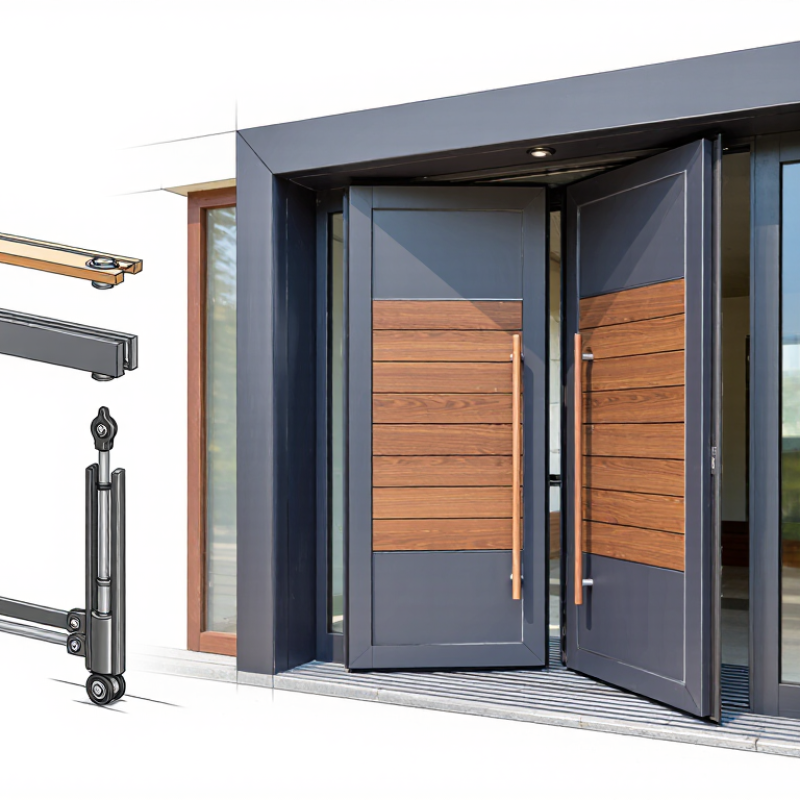
Define Large Pivot Doors by Panel Size, Pivot Position, and Structural Load Path
Large pivot doors are defined by more than an impressive opening. Panel height, width, thickness, and material determine its weight and stiffness. A 1.5-meter-wide timber leaf behaves differently from a similarly sized glazed panel. Record the finished panel dimensions, not just the rough opening. Small measurement gaps matter.
Pivot position changes how the door moves. A centered pivot divides the panel’s swing more evenly, while an offset pivot creates a wider leading edge and different clearance needs. Check the sweep radius against nearby walls, handles, flooring, and furniture. A mock-up on the floor can reveal awkward conflicts before installation. It is easy to overlook the handle.
The structural load path deserves equal attention. The panel’s weight transfers through the pivot hardware into reinforced points at the floor and head, then into the supporting structure. A decorative ceiling finish is not a structural header. Confirm substrate strength, anchor locations, and floor capacity with the project’s qualified design and installation team. Heavy leaves can move quietly. Their support system cannot be guessed. Share panel weight and hardware details early, since late changes may require new reinforcement or revised clearances.
Identify 7 Global Manufacturers by Materials, Customization, and Export Reach
A practical global shortlist can compare seven manufacturer profiles rather than relying on glossy photos alone. Some specialize in thermally broken aluminum frames, while others focus on steel pivot systems for slim sightlines. Hardwood producers offer warm grain and varied finishes, but buyers should ask how timber is dried and sealed. Glass-focused makers can create broad, light-filled entrances. Strong samples matter.
Other suppliers stand out through oversized engineering, unusual finishes, or made-to-measure hardware. A large pivot door depends on more than its panel: hinges, floor pivots, seals, and frame reinforcement must work together. Ask for drawings, load data, finish samples, and installation guidance. A confident answer is useful; a vague one deserves follow-up.
Export reach is another useful comparison point. Look for manufacturers that regularly prepare protective crating, clear packing lists, and shipment updates for international projects. Confirm who handles freight coordination and what documentation accompanies the order. These details can affect timing as much as production. This framework is imperfect; regional suppliers may offer excellent work but publish little export information. Compare verified project references, customization limits, and realistic lead times before choosing.
Compare Air Permeability Under EN 12207 Classes 1–4
For global buyers comparing large pivot doors, EN 12207 offers a useful way to assess air permeability. It assigns Classes 1 to 4, with Class 4 representing the tightest leakage limits. The classification comes from testing air leakage at defined pressure steps, rather than judging a door by its seals or appearance. That distinction matters. A heavy leaf can feel solid and still allow drafts around its edges.
Ask for the test report, not just a class label. Check that the tested specimen resembles the proposed door in size, frame, seals, and locking arrangement. Large pivot leaves can flex under pressure, while uneven floors or installation gaps may weaken performance on site. Real sites are less tidy. A high class may suit exposed locations, but it is not automatically the best choice for every building. Compare the reported leakage values and test conditions, then consider wind exposure and installation quality. I would also leave room for doubt: a laboratory result cannot guarantee identical performance after years of use. Regularly inspect seals and pivot alignment, especially on wide, frequently used doors.
7 Best Large Pivot Door Manufacturers for Global Buyers? — Compare Air Permeability Under EN 12207 Classes 1–4 Anonymous, standards-based buyer comparison guide. The figures below are EN 12207 class limits—not manufacturer-specific test results or a verified ranking. | Comparison item | At 100 Pa
Airflow per area | At 100 Pa
Airflow per joint length | At 600 Pa
Airflow per area | At 600 Pa
Airflow per joint length | What global buyers should check |
| 1. EN 12207 Class 1 | ≤ 50 m³/(h·m²) | ≤ 12.50 m³/(h·m) | ≤ 150 m³/(h·m²) | ≤ 37.50 m³/(h·m) | Lowest of the four classes shown for air-tightness. Compare the declared class with the project’s exposure and performance requirements. |
| 2. EN 12207 Class 2 | ≤ 27 m³/(h·m²) | ≤ 6.75 m³/(h·m) | ≤ 75 m³/(h·m²) | ≤ 18.75 m³/(h·m) | A tighter classification than Class 1. Confirm that the tested result covers the specified pivot-door configuration. |
| 3. EN 12207 Class 3 | ≤ 9 m³/(h·m²) | ≤ 2.25 m³/(h·m) | ≤ 20 m³/(h·m²) | ≤ 5 m³/(h·m) | A tighter classification than Class 2. Request the test report and check the specimen dimensions, seals, threshold, and hardware. |
| 4. EN 12207 Class 4 | ≤ 3 m³/(h·m²) | ≤ 0.75 m³/(h·m) | ≤ 10 m³/(h·m²) | ≤ 2.5 m³/(h·m) | Highest air-permeability class in this scale. Verify that the offered product—not just a similar door—has supporting test evidence. |
| 5. Test method | EN 1026 is the test method; EN 12207 is the classification standard. | Ask for a traceable report identifying the test method, classification, specimen, and issuing laboratory. Do not treat a class claim alone as a complete test record. |
| 6. Tested specimen | The reported result applies to the specimen and configuration described in the test documentation. | Compare tested and specified leaf size, frame, opening arrangement, seals, threshold, and locking or pivot hardware. Confirm whether the report covers the size being purchased. |
| 7. Product variations | A change to the tested assembly may affect whether its classification remains applicable. | For changes to dimensions, components, or installation details, request written confirmation that the test evidence applies to the proposed doorset. |
Assess Water Tightness and Wind Resistance Using EN 12208 and EN 12210
For a global buyer comparing large pivot doors, ask for test reports tied to the actual door size and configuration. EN 12208 classifies water tightness, with classes 1A to 9A tested at increasing pressure; class 9A corresponds to 600 Pa. Higher-pressure Exxx classes are also possible. The classification is useful, but it does not guarantee performance after poor installation or neglected seals. Details matter.
EN 12210 classifies resistance to wind load. Its pressure classes run from class 1 at 400 Pa to class 5 at 2,000 Pa, alongside separate ratings for frame deflection. These figures come from the classification tables in the European standards; EN 1027 and EN 12211 specify the related water and wind test methods. Ask whether the report covers the proposed panel dimensions, hardware, glazing, and opening direction. A small test specimen may not represent a very wide pivot leaf.
Look closely at thresholds, corner joints, and the pivot-side seals. These are common weak points on oversized doors. Check the water test pressure and wind deflection class, not just a headline rating. Not enough alone. A report cannot predict every exposed site, and installers can still miss a seal adjustment. That caveat is worth taking seriously.
Evaluate Thermal Performance, Hardware Capacity, Warranties, and After-Sales Support
Choosing among large pivot door manufacturers requires more than comparing panel sizes. Thermal performance is a practical starting point. The U.S. Department of Energy’s Energy Saver guidance estimates that heat gain and loss through windows account for about 25–30% of home heating and cooling energy use. That figure is not specific to pivot doors, but it shows why glazing and frame performance deserve close review. Ask for independently verified U-factor and solar heat gain coefficient ratings, plus air-leakage test results for the complete door assembly. NFRC ratings help buyers compare products on a consistent basis. Small gaps matter.
Hardware capacity needs equally careful checking. Request the tested maximum panel weight and dimensions, pivot-set load rating, and details for floor preparation. A heavy door may look effortless in a showroom, yet still require precise alignment and a suitable structural substrate. Ask how the supplier accounts for wind loads, repeated use, and accessible adjustment points. Brochure claims alone are not enough.
Warranty terms and after-sales support can reveal how a manufacturer handles real-world problems. Check coverage for finishes, seals, glass, and moving hardware separately; exclusions often sit in the details. Confirm who responds to service requests, whether replacement parts remain available, and how quickly technical guidance can be provided. A polished warranty may still leave one awkward question: who adjusts the door after installation? Get that answer in writing before ordering.