Top 10 Winfort Commercial Smart Lock Types for Global Buyers
Choosing a commercial smart lock is rarely a simple matter of comparing prices and features. Global buyers must consider door materials, traffic levels, access policies, installation skills, and long-term service support. This guide introduces the top 10 Winfort commercial smart locks types for offices, hotels, warehouses, apartments, and other professional properties. Each type serves a different operational need, from keypad entry and RFID cards to fingerprint recognition, mobile credentials, and remote management.
Real projects often reveal details that product pages overlook. A busy hotel entrance may need fast card recognition, while a warehouse may require stronger hardware and clearer permission control. A glass office door can demand different fittings from a metal security door. Small issues matter, such as battery access, emergency power, audit-log storage, and whether existing access systems can be integrated. No single model wins every door.
Reliable selection also depends on evidence. Buyers should review installation instructions, warranty terms, software support, cybersecurity practices, and the availability of replacement parts in their region. Professional installers can confirm door thickness, lock-body compatibility, fire-safety requirements, and network conditions before purchase. Testing one sample door is wise. A neat specification sheet can still mislead.
This overview compares Winfort commercial smart locks by design, access method, management features, security role, and practical deployment environment. It also highlights limitations, because a lock that performs well in a quiet office may struggle under constant public use. The goal is a clear, experience-based starting point for safer, more efficient purchasing decisions across international markets.
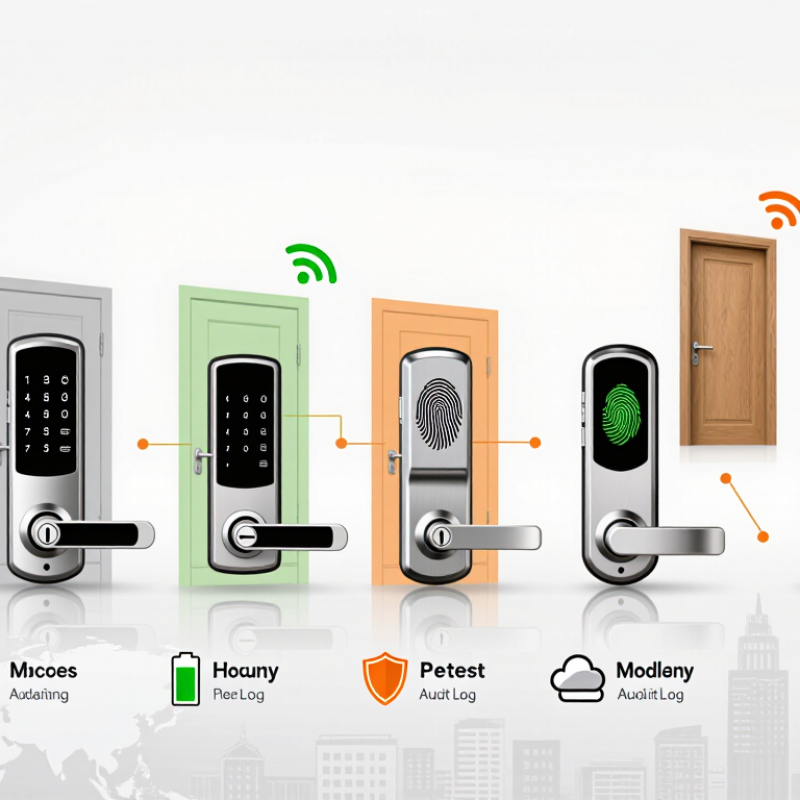
Commercial Smart Lock Taxonomy: 10 Winfort Types by Access Method
Commercial smart locks are best compared by access method, not appearance.
Global buyers commonly evaluate ten types: PIN keypad, RFID card, NFC phone, Bluetooth app, Wi-Fi remote, fingerprint, palm-vein, facial recognition, mechanical key override, and multi-factor locks.
Each suits a different operating scene. A keypad works well at a warehouse side door. RFID supports quick staff entry near reception.
NFC and Bluetooth reduce contact with physical credentials. Wi-Fi helps managers monitor distant offices, but network dependence needs attention.
Fingerprint and palm-vein models fit controlled workplaces with steady users. Facial recognition can support hands-free passage, although lighting and privacy procedures affect reliability. Mechanical-key override provides emergency access during power or device failure. Multi-factor locks combine methods, such as card plus PIN, for server rooms or finance areas.
In field testing, installation quality often matters more than advertised features. A misaligned latch can defeat an excellent reader. That lesson is easy to overlook.
Tips:
Map each doorway before purchasing. Record traffic volume, door material, power availability, and indoor conditions. Test gloves, wet fingers, weak signals, and forgotten credentials. Keep an audit trail for access changes. Do not assume one type fits every door. A mixed deployment may cost more initially, yet it can simplify maintenance and reduce daily friction. Review failure logs monthly. Some assumptions will need revision.
Mechanical-Keypad and RFID Locks: ANSI/BHMA A156.36 Grade Criteria
When comparing the top ten commercial smart lock types, global buyers should separate access technology from lock strength. Mechanical-keypad locks use coded buttons, while RFID locks read cards or credentials. Neither feature automatically proves ANSI/BHMA performance. ANSI/BHMA A156.36 mainly covers auxiliary locks, including certain deadlocks and latches. Its grade system helps assess durability and security under controlled testing. Grade 1 generally represents the highest commercial performance, followed by Grades 2 and 3. Higher grades usually require stronger construction and longer cycle endurance.
Check the exact product configuration. A keypad deadlock may fall under A156.36, while an RFID mortise or electrified lock may require another applicable standard. Ask suppliers for the current test report, tested grade, cycle rating, strike details, and installation conditions. Do not rely on a sales phrase such as “commercial grade.” The door, frame, hinge alignment, and fasteners also affect field results. Small gaps can create large security problems. A lock may pass laboratory testing but perform poorly on a warped aluminum door. I have seen buyers focus on reader range and overlook emergency operation. That is an avoidable mistake. Confirm credential management, battery alerts, audit records, weather exposure, and fire-door compatibility before ordering. When reviewing ten lock types, compare evidence rather than appearance. A polished keypad is not proof of Grade 1 performance.
Mobile, Wi-Fi, and Bluetooth Locks: Connectivity Range and Battery Data
For global buyers comparing the top ten commercial smart lock types, connectivity affects daily reliability. Mobile-enabled locks usually communicate through a smartphone application and Bluetooth. Typical Bluetooth range reaches 10 to 30 meters indoors, depending on walls, doors, and interference. Wi-Fi locks offer remote control through an existing network. Their practical indoor range often reaches 20 to 50 meters, but concrete walls can reduce it sharply. Some mobile systems use cellular communication for remote sites. They work beyond local Bluetooth range, yet subscription and signal coverage require careful review.
Battery performance varies more than product pages suggest. Bluetooth keypad locks commonly provide six to twelve months from four AA batteries. Wi-Fi models may last three to six months because constant network communication consumes more power. Fingerprint, card, and motorized deadbolt designs can shorten runtime during heavy traffic. Rechargeable lithium batteries may support three to nine months, but cold conditions can reduce capacity. Always check whether emergency USB power or a mechanical override is available.
In field checks, measure range through the actual doorway, not an empty showroom. A lock may connect beside the entrance but fail in a basement corridor. Ask suppliers for test conditions, battery chemistry, access frequency, and standby data. These details matter. I would not rely on claimed range alone. A small pilot installation often reveals missed handoffs, weak signals, or faster battery drain. That imperfect evidence is still more useful than a polished specification sheet.
IP-Rated, Fire-Door, and Exit-Device Locks: Compliance for Global Markets
Commercial smart locks must match the door, building risk, and target market. IP-rated models help protect readers, controllers, and wireless components from dust and moisture. An IP rating is not a general quality promise. It describes tested resistance under defined conditions. Outdoor entrances may need stronger protection than dry interior doors. Check seals, cable routes, temperature range, and installation quality.
Fire-door applications require careful coordination with the complete door assembly. The lock, strike, hinges, closer, and frame should support the required fire performance. A smart lock must not prevent safe release during an emergency. Fire testing documents, compatible hardware, and local approval records deserve close review. Small gaps around the frame can create serious problems. They are easy to overlook.
Exit-device locks support controlled access while allowing rapid escape from the protected side. Buyers should verify panic hardware compatibility, fail-safe or fail-secure behavior, emergency power operation, and signage requirements. Requirements vary across regions, even when product names appear similar. Ask for test reports, installation instructions, maintenance schedules, and traceable production records. A checklist helps, but it is not enough. Real site conditions often expose weak assumptions. Test the complete door before shipment and again after installation. Reliable compliance depends on evidence, correct fitting, and regular inspection.
Top 10 Commercial Smart Lock Types for Global Buyers
Representative compliance benchmarks for IP-rated, fire-door, and exit-device applications across international markets.
The chart compares commonly specified ingress-protection levels and fire-door resistance benchmarks. Actual approval requirements vary by door assembly, installation method, jurisdiction, and certification scheme; buyers should verify applicable IEC 60529, EN, UL, NFPA, or local requirements before procurement.